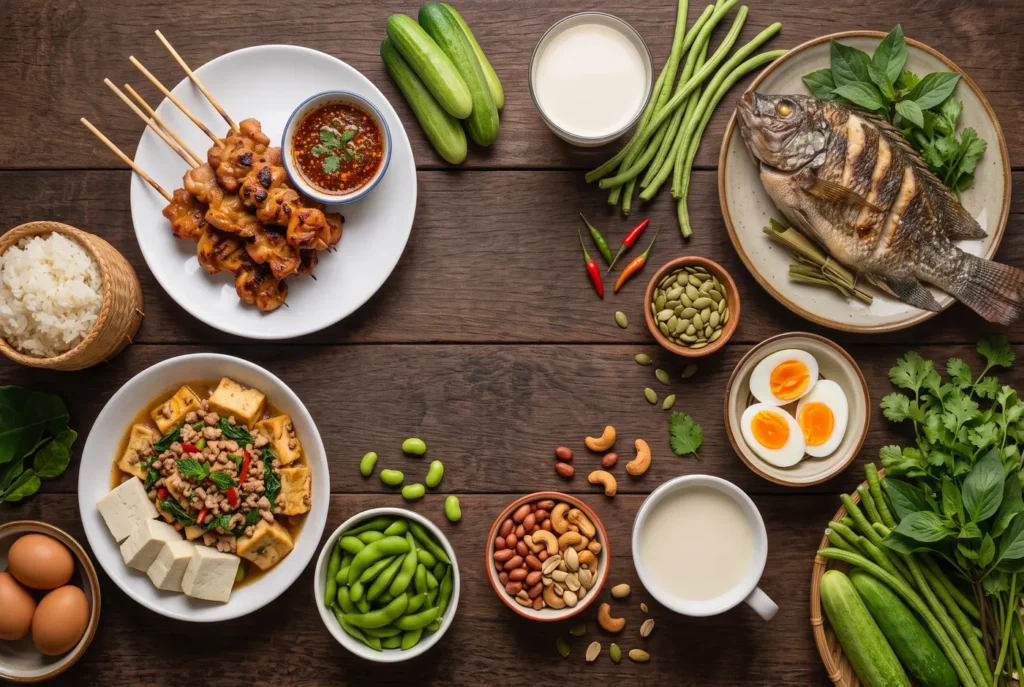
The word “healthy” on a delivery box is a claim, not a measurement. Here is how to judge healthy food delivery in Bangkok on the things that matter: how reliable the numbers are, hidden sodium, food safety in the heat, real prices, and terms that lock you in.
Healthy food delivery in Bangkok is a crowded market. Clean-eating brands, macro-counted meal prep, frozen packs, chef-cooked daily plans and restaurant apps all sell some version of the same promise: eat well without cooking. Some of them deliver it. Many rely on words like “clean,” “no MSG,” and “50 g protein” that say less than they appear to.
This guide covers what these services are, what the research says about them, and five checks worth making before you pay: the numbers, the salt, the delivery, the price, and the terms.
What healthy food delivery in Bangkok actually covers
Clean food delivery in Bangkok and meal prep delivery in Bangkok are overlapping labels for one basic product: cooked meals, portioned, sent to your door. Underneath, the category blends several products that behave differently.
Fresh-daily meal prep. Meals cooked that morning, labelled with macros and delivered the next day. Usually the most expensive, and the most carefully marketed.
Chilled batches on a schedule. Cooked meals delivered cold in batches. Often cheaper per meal, with a shelf-life you have to manage.
Frozen packs. Thai-style dishes frozen and sold in packs of 20 to 90. The cheapest per meal, and the most dependent on you reheating properly.
Restaurant delivery. Healthy cafes and restaurants on the major apps, with no meal-plan structure and often no verified nutrition data.
If you want help deciding what to eat in the first place, a nutrition coach or dietitian answers a different question, and our guide to nutrition coaching versus seeing a dietitian explains who to ask.
What the research says about meal delivery
The evidence is modest, and it points in a useful direction. A randomized trial published in Food and Nutrition Research compared an eight-week home-delivered diet meal service combined with dietary counseling against counseling alone in women with overweight or obesity. Both groups improved on weight, waist circumference, blood glucose, lipids, and blood pressure. The meal-service group improved somewhat more, but the difference between groups was not statistically significant. The authors credit the service with making adherence easier by removing meal planning and portion decisions.
A meal service is a convenience tool. It makes a plan easier to follow, not smarter.
That is the right way to think about it. The service helps if you were failing at the logistics. It does not fix a plan that does not suit you, and a trial of older adults who switched from home cooking to ready-made meals found that protein intake fell unless they picked protein-rich options on purpose. Check the actual numbers on what you order, using our protein guide to work out what is sensible for you.
Can you trust the numbers on the box?
Not blindly. Independent laboratory testing of reduced-calorie prepared foods found that restaurant meals averaged 18 percent more calories than stated, and frozen supermarket meals averaged 8 percent more, with some items containing up to double the stated amount. Lower-calorie meals were the least accurate. That study was done in the United States on a small sample, so it does not tell you about any Bangkok provider. It does tell you that a printed calorie figure is not proof.
So ask how the numbers were produced. Calculated from a recipe database is an estimate. Weighed portions are better. Laboratory analysis is the only independent check. One Bangkok provider says its macros are weighed on calibrated scales and accurate to within 5 percent, which is the right kind of claim, specific and testable, but a claim on a provider’s own website is not verification.
Treat these as marketing language rather than information:
- “Clean.” It has no agreed meaning.
- “No MSG.” This says nothing about total sodium, which is the real issue in Thai food.
- “Detox” or “fat-burning.” No meal does either.
- “Calorie-tiered plans” sold as a diet. Fixed calorie tiers are not suitable for everyone, so talk to a doctor or dietitian rather than choosing from a website if you have a medical condition or a difficult relationship with food.
Check the sodium
This is the Bangkok-specific check most guides skip. A national health survey for 2024 to 2025 found that Thais aged 15 and over average about 3,650 mg of sodium a day, and 88.2 percent exceed the WHO’s 2,000 mg daily limit. A Thai survey reported in the Bangkok Post found frozen foods averaged 890 mg of sodium per package, above the 600 mg per meal that officials cited as a benchmark. Fish sauce, soy sauce, seasoning powders, and instant noodles are the usual culprits.
A “healthy” plan built on Thai flavors can therefore still be salty. Ask for sodium per meal, look at it on the label, and be skeptical of a provider that lists calories and protein but not sodium.
Delivery and food safety in the heat
Perishable food has a time limit, and Bangkok’s heat shortens it. The US Department of Agriculture advises refrigerating delivered perishable food within two hours, and within one hour when the air temperature is above 32 degrees Celsius (90 Fahrenheit). Bacteria grow fastest between 4 and 60 degrees, and can double in as little as 20 minutes.
In practice:
- Ask how meals travel. Insulated, cold-chain delivery is different from a bag on a motorbike.
- Take deliveries in promptly. A box sitting in a lobby or on a doorstep counts against the clock.
- Look for cook dates and use-by dates on every container.
- Reheat thoroughly. US health authorities advise heating food to 74 degrees Celsius (165 Fahrenheit).
- If in doubt, throw it out. Spoiled food often looks and smells normal.
Also ask what food-safety certification the kitchen holds, such as HACCP or GMP, and what allergen information is on the label.
Healthy meal delivery in Bangkok: what it costs
Prices vary with the type of service, the portion size, and the plan length. These were checked on provider pages in October 2026 and are examples, not recommendations.
| Provider (example) | Type | Listed price | What to know |
|---|---|---|---|
| Cleanfit | Frozen packs | From about 44 to 50 baht per main dish | Rice is extra, packs of 21 to 90 meals |
| Harvest Clean Food | Cold-chain meal prep | From 129 baht per meal | Advertises protein-first meals and delivery from 79 baht in Bangkok |
| Homie Clean Food | Fresh-daily meal prep | Roughly 235 to 425 baht per meal | Single orders and weekly passes differ, advertises 50 g or more of protein per meal |
| NutriChef | Chef-prepared full-day plans | One-day trial from 990 baht | A partner of Aspire, which is part of the same network as this site, and Aspire says it takes no payment from it |
Delivery companies’ own estimates put home cooking at roughly 60 to 150 baht per meal in ingredients, so treat that comparison with caution. For scale, one provider’s plans of 60 and 90 meals a month list at 16,499 and 21,999 baht, and our price guide shows how that compares with other fitness costs.
The terms to read before you subscribe
- Pause and cancel rules. Can you skip a week without penalty?
- Minimum purchase and delivery fees. A low per-meal price can hide a delivery charge.
- A trial option. A single-day or single-week trial is a better test than a month.
- Menu rotation. Eating the same four dishes is a quick route to quitting.
- Packaging. Check that containers are microwave-safe before reheating.
A five-minute checklist
- Where do the macros come from: a database, weighed portions, or lab analysis?
- Is sodium per meal listed, and is it reasonable?
- How are meals kept cold, and when do they arrive?
- Do cook dates, allergens, and reheating instructions appear on the label?
- Does the protein per meal fit what you actually need, rather than a marketing number?
- Can you pause, cancel, or trial it without penalty?
The short version
Healthy food delivery in Bangkok is best treated as a convenience tool that makes consistency easier, not a health intervention in itself. The one trial we found showed that a delivered-meal plan and counseling alone both improved health markers, with no statistically significant advantage for the meal service. Independent testing shows printed calorie figures on prepared food can run high, so ask how the numbers were produced. Thai diets are already high in sodium, so check it per meal, because “clean” and “no MSG” say nothing about salt. In Bangkok’s heat, perishable meals should be refrigerated within an hour of arriving. Expect roughly 44 to 425 baht per meal depending on the type, and read the pause, cancel, and delivery terms before you subscribe.
This guide will be updated as Bangkok providers, prices, and food-safety guidance change. If you’re a dietitian or run a meal service and believe a detail here needs correction, contact us.
Sources
- Journal of the American Dietetic Association (2010): The Accuracy of Stated Energy Contents of Reduced-Energy, Commercially Prepared Foods
- Nation Thailand (2026): 88% of Thais Exceed Daily Sodium Intake, Government Introduces Salt Tax to Combat Health Risks
- USDA Food Safety and Inspection Service: Safe Handling of Take-Out Foods
- Food and Nutrition Research (2026): Evaluating Home-Delivered Meal Service Programs for Obesity, A Randomized Controlled Approach