Healthy eating in Bangkok without cooking is easy to do and easy to get wrong. The food is plentiful and cheap, but the usual traps are salt, sugar in drinks, and plates with almost no protein. Here is what Thailand’s own guidance says, where the traps are, and how to order around them.
Healthy eating in Bangkok without cooking is entirely possible. Street stalls, food courts, convenience stores, and delivery apps put a meal within a few minutes’ walk of almost anywhere in the city. The challenge is not availability. It is that the most common dishes are built on salty sauces, sweet drinks sit next to every meal, and protein varies wildly from one plate to the next.
This guide covers what Thai health authorities recommend, the three traps that catch most people, and practical ways to order at stalls, food courts, and convenience stores. For ordering in, see our guide to healthy food delivery in Bangkok.

Healthy eating in Bangkok: what Thailand’s own guidance says
Thailand has had national food-based dietary guidelines since the 1980s, communicated through the “Nutrition Flag,” a hanging-flag diagram whose layers show how much of each food group to eat. The guidance asks for rice or other starches as the base, plenty of vegetables and fruit, fish, lean meat, eggs, and legumes in appropriate amounts, and limited oil, sugar, and salt. Its nine guidelines also include avoiding excessive sweet and salty food, eating clean and safe food, and cutting back on alcohol. The flag suggests roughly four to six rice-serving spoons of vegetables a day and three to five portions of fruit.
None of that is exotic, and Thai cuisine already has the ingredients. The gap is in how the food is prepared and sweetened, which brings us to the traps.
Trap one: salt
Thais average about 3,650 milligrams of sodium a day, against the WHO’s limit of 2,000, and the main sources are not the salt shaker but fish sauce, soy sauce, curry paste, and seasoning in broths and dressings. A Thai Health Promotion Foundation survey found that 23 of 25 popular dishes ordered through delivery apps were high in sodium, and Thai health officials cite 600 milligrams per meal as a benchmark.
Measured values for individual dishes vary enormously between sources and stalls, so treat the figures below as indicative.
| Dish | Reported sodium (mg per dish) | Source note |
|---|---|---|
| Som tam with fermented fish or salted crab | About 1,900 to 5,000 | The low figure is from kidney specialists, the high from a Thai Health Promotion Foundation survey |
| Creamy tom yum goong | About 1,700 | Kidney specialists |
| Massaman curry | About 1,300 | Kidney specialists |
| Pad Thai | About 1,100 | Kidney specialists |
| Green curry with chicken | About 870 | Kidney specialists |
| Boat noodles | About 840 | Kidney specialists |
| Instant noodles, one package | About 1,240 average | Thai survey of 300 products |
| Frozen meals, one package | About 890 average | Thai survey of 53 products |
The practical lesson is that “healthy-looking” does not mean low in sodium. A salad dressed in fish sauce and a bowl of clear-looking soup can carry as much as a plate of fried noodles.
Trap two: sugar in drinks
According to Thailand’s Department of Health, Thais eat about 21 teaspoons of sugar a day, more than three times the WHO’s limit of six, and drinks are a major source. A government survey found that a 650 ml iced coffee averages about nine teaspoons of sugar, and a 300 ml bubble milk tea can contain up to 12.
Since February 2026, nine major coffee chains have halved the default sugar in some drinks, though each brand applies it to certain menu items only. You can go further. Many cafes and tea shops offer sweetness levels such as 25 or 50 percent, and at a street stall you can ask for “wan noi” (less sweet) or “mai sai nam tan” (no sugar). Plain water, unsweetened tea, and black coffee need no negotiation at all.
Trap three: plates with little protein
Many classic Thai plates are built on rice or noodles, with a modest amount of meat or egg on top, so protein varies a lot. Our protein guide shows rough ranges by dish, from substantial plates like khao man gai to light ones like plain som tam. If you eat mostly street food and noodle soups, check whether each meal has a real protein serving, rather than assuming it does.
Healthy street food in Bangkok: how to order
Healthy street food in Bangkok mostly comes down to choosing the cooking method and controlling the sauces.
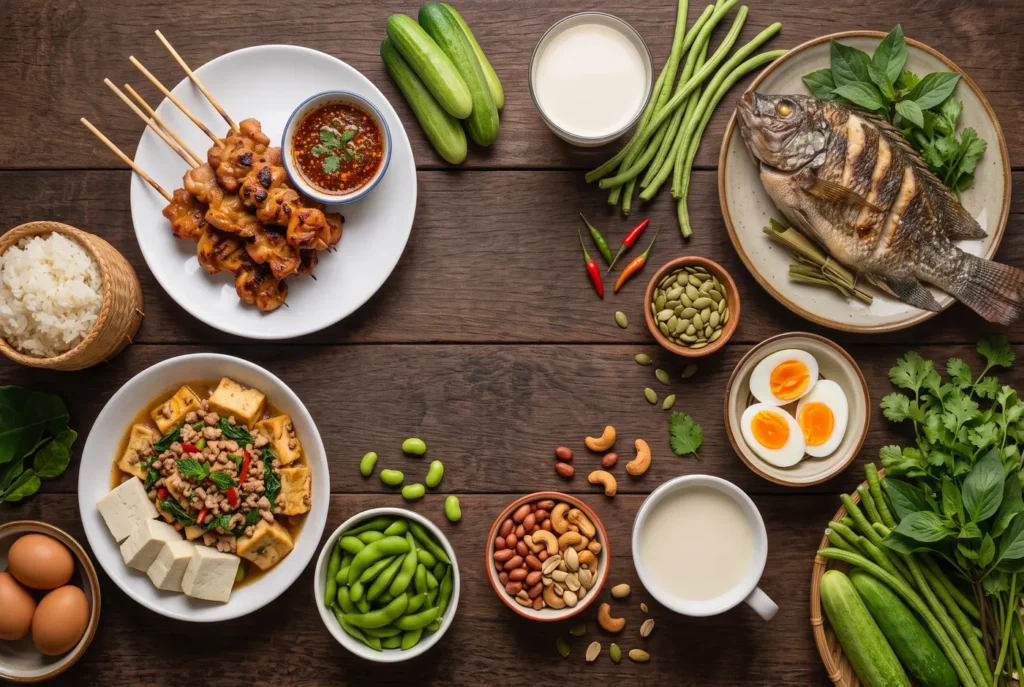
- Choose grilled, steamed, or boiled protein. Grilled chicken, grilled fish, pork skewers, steamed fish, and boiled eggs are everywhere, and they are easier to pair with vegetables and rice than fried dishes.
- Ask for more vegetables. “Kho phak phoem” (more vegetables) is a normal request at most stalls.
- Go easy on the sauce. Ask for “khem noi” (less salty), leave sauce packets unopened, and put dips on the side.
- Treat noodle soups differently. Much of the sodium in a noodle soup sits in the broth and seasoning, so eating the noodles and toppings and leaving most of the broth is a simple way to cut salt.
- Watch salad dressings. Som tam and yum dressings are fish sauce, lime, and sugar, so ask for less fish sauce, and skip the salted crab and fermented fish versions if you are watching salt.
- Pick a drink with no added sugar.
These Thai phrases are approximate transliterations, so check them with a Thai speaker if you want to be sure.
Food courts, restaurants, and convenience stores
Food courts make it easy to build a plate from several stalls: a grilled or steamed protein, rice, a vegetable dish, and a clear soup or water. The variety is the advantage, so avoid defaulting to the same fried noodle stall.
Convenience stores. A 7-Eleven can cover a lot. Price guides list boiled eggs at roughly 5 to 20 baht, packaged ready-to-eat chicken breast at about 35 to 40 baht, boxed salads at about 40 to 80 baht, and ready meals at around 50 baht. A nutrition-tracking site that catalogs these meals lists protein of around 19 to 22 grams for some of them, and sodium in the hundreds of milligrams, but labels and stock change, so read the panel on the pack. Healthy 7-Eleven food in Thailand is easy to assemble from a protein, a salad, and a drink with no added sugar.
Look for the Healthier Choice logo on packaged foods. Thailand’s nutritional logo scheme sets limits on sugar, fat, saturated fat, and sodium by food category, so a product that carries it has met those criteria. It is a quick filter, not a guarantee that a product is right for your needs. On any label, compare sodium with the 600 milligram per meal benchmark and note the sugar.
Restaurants. Ask for sauce on the side, request a grilled or steamed preparation, and ask for the dish with less sugar and less fish sauce. Most kitchens will accommodate.
Delivery and meal plans
Delivery apps add convenience and the same sodium problem: 23 of 25 popular delivery dishes in the Thai survey were high in sodium. Our guide to healthy food delivery covers how to judge a meal-plan provider, what the numbers on the box mean, and what it costs. For nutrition help from a professional, see our guides to nutrition coaching and to coaching versus a dietitian.
A simple way to build any meal
How to eat healthy in Bangkok without a plan? You do not need one. For any meal without cooking, check four things:
- Is there a protein? An egg, grilled chicken, fish, tofu, or meat.
- Is there a vegetable? A side, a salad, or vegetables in the dish.
- Is there a starch? Rice, noodles, or bread, as the Nutrition Flag expects.
- Is the drink sugar-free? Water, unsweetened tea, or black coffee.
Then think about the sauce. This is a pattern, not a rule, and it works the same at a street stall, a food court, or a convenience store. Our price guide shows what meals and delivery cost compared with other spending.
Who needs to be more careful
Sodium and sugar matter more if you have high blood pressure, kidney disease, or diabetes, and general advice is not a substitute for your doctor’s or a dietitian’s. A blood pressure reading is one of the markers worth knowing, as our biomarker testing guide explains. This guide gives no calorie targets, and if worrying about food is starting to take over, it is worth speaking to a health professional.
The short version
Healthy eating in Bangkok without cooking comes down to handling three traps. Salt comes first: Thais average about 3,650 mg of sodium a day, and many dishes, from som tam to creamy tom yum, carry a day’s worth in one serving. Sugar in drinks comes second, since a large iced coffee averages about nine teaspoons. The third is plates with little protein. Order grilled, steamed, or boiled protein, ask for more vegetables and less fish sauce, leave most of the noodle-soup broth, choose a drink with no added sugar, and use sweetness levels. A 7-Eleven can supply eggs, chicken, salad, and ready meals cheaply, and the Healthier Choice logo is a quick filter. Check any meal for a protein, a vegetable, a starch, and a sugar-free drink, and speak to a doctor or dietitian if you have a medical condition.
This guide will be updated as Thai nutrition guidance and Bangkok’s food landscape change. If you’re a dietitian or nutrition researcher and believe a detail here needs correction, contact us.
Sources