
Most healthy adults who eat meat, fish, or eggs regularly are closer to their protein needs than the marketing suggests. What changes the answer is whether you lift, how old you are, and what your usual plate looks like. Here is what the research says, how common Thai dishes compare, and what to ignore.
Protein intake in Bangkok is a strange mix of too much talk and too little precision. Gyms and cafes sell protein shakes, packaged snacks carry “high protein” banners, and every other conversation among people who train seems to include a number in grams. Meanwhile the city’s most common meals are built around rice and noodles, and protein quietly varies from plate to plate.
The question most people actually ask is simple: how much protein do I need? This guide covers the published research on how much protein different people need, whether more is risky, what typical Thai dishes actually deliver, and how to read protein marketing without being sold to.
What the research says you need
Three reference points matter, and they answer different questions. All are expressed per kilogram of body weight per day, and all describe groups of people, not a personal prescription.
General adults: about 0.8 grams per kilogram. This is the standard recommended dietary allowance for adults. It is set to cover the needs of nearly all healthy people, which makes it a floor to avoid deficiency, not an optimum for muscle, strength, or recovery.
People who lift: gains flatten out near 1.6 grams per kilogram. A meta-analysis of 49 trials with 1,863 participants found that protein supplementation added to resistance training improved lean mass and strength. Benefits stopped adding up beyond a total intake of roughly 1.6 grams per kilogram per day, although the confidence interval stretched from about 1.0 to 2.2. The effect was larger in people who were already trained and smaller in older people.
Adults over 65: at least 1.0 to 1.2 grams per kilogram. The PROT-AGE study group, an international expert panel, argues the standard allowance is too low for older people, who respond less to dietary protein and are at higher risk of muscle loss. It recommends more for those who exercise, and more again for those with illness. It also names an exception: people with severe kidney disease may need to limit protein.
The official number is a floor, not a goal. The research number is a ceiling for most of the benefit, not a target to beat.
To translate grams per kilogram into daily grams, multiply by your body weight in kilograms. For illustration only, a 70 kg adult at the 0.8 figure comes to about 56 grams a day, and the training research figure is roughly double that. Your own number depends on your goals, health, and diet, which is a conversation for a doctor, dietitian, or coach, and our guide to nutrition coaching versus seeing a dietitian explains who to ask.
Is more protein risky?
The usual worry is the kidneys. A 2018 systematic review and meta-analysis in the Journal of Nutrition compared higher-protein diets (defined as at least 1.5 grams per kilogram, or a fifth of energy) with normal or lower ones in healthy adults. Higher protein produced higher filtration rates, but the change in kidney function over time did not differ between groups. The authors concluded that higher intakes do not adversely affect kidney function in healthy adults.
The caveat matters. That finding is about healthy kidneys. If you have kidney disease, are pregnant, or are managing another medical condition, general ranges do not apply and your doctor’s advice does. And since benefits for training flatten out at around 1.6 grams per kilogram, eating far beyond that buys expense and inconvenience rather than muscle.
Protein intake in Bangkok: what a Thai plate actually delivers
Bangkok’s everyday dishes cover a wide range. Nutrition databases disagree with each other, and portions vary from stall to stall, so treat the figures below as rough estimates from one fitness-industry guide rather than lab measurements.
| Dish (one plate) | Rough protein (grams) | What to know |
|---|---|---|
| Pad kra pao with rice and egg | 25 to 40 | Depends on the meat and portion |
| Khao man gai | 25 to 40 | One of the more protein-rich everyday plates |
| Pad Thai | 15 to 30 | Noodles dominate, protein varies widely |
| Som tam | 3 to 8 | Light and fresh, but low in protein |
| Som tam with grilled chicken | 30 to 50 | Adding a grilled protein changes the picture |
The pattern is the useful part. Many classic Thai meals sit on rice, noodles, or sticky rice, and the protein component is whatever meat or egg sits on top. A plate with a clear protein serving can deliver a respectable share of a day’s baseline in one sitting. A lighter dish, a salad, or a noodle soup with little meat may deliver far less. Using the earlier illustration, two substantial protein plates would roughly cover 56 grams, and roughly doubling that takes more planning than most people expect.
None of that means eating more of everything. It means noticing which of your regular meals carry a protein serving and which do not, then deciding whether it matters for your goals.
Protein sources in Bangkok that need no special products
There is no shortage of high protein Thai food, and familiar sources do most of the work:
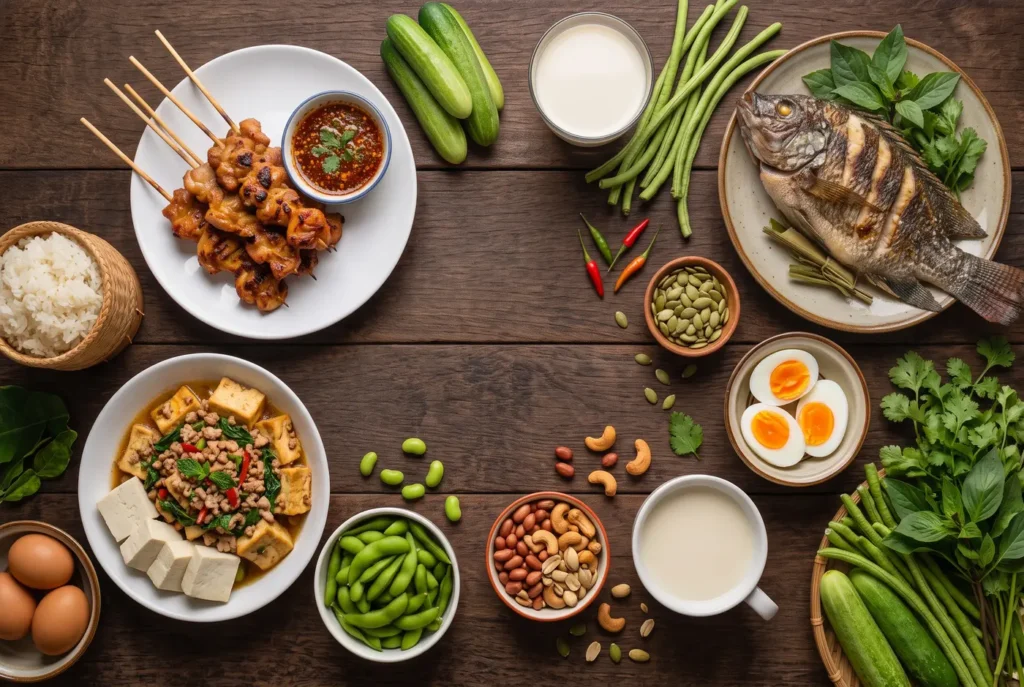
- Grilled and stir-fried meat or fish. Grilled chicken, pork skewers, grilled fish, and basil stir-fries are everywhere, and asking for extra meat or an egg on top is a normal request.
- Eggs. Cheap, available at almost every stall and convenience store, and easy to add to a plate.
- Tofu, soy products, and legumes. Useful for vegetarians and during the vegetarian festival period, when meat-free menus are widespread.
- Larb and similar salads. A minced-meat salad packs far more protein for its size than a plain papaya salad.
- Dairy. Milk and yogurt contribute a useful share of protein, and they are easy to find everywhere.
If you eat in a restricted window, our time-restricted eating guide covers how to fit meals around a Bangkok workday, and the same practical logic applies to making sure your window contains real protein servings.
Protein powder and “high protein” labels
Protein powder is a convenience food, not a requirement. For many people it is a handy way to add protein without cooking, and it is no better than the same protein from eggs, fish, or meat on a plate. We do not give scoop sizes, timing schedules, or brand picks here, because that belongs in a conversation with a doctor or coach who knows your situation, ideally alongside bloodwork. Our supplements guide covers the category-level picture, including how to judge product claims.
For packaged snacks with a protein banner, judge the whole product: how much protein per serving, how much sugar and fat comes with it, and what it costs per gram compared with a plate of real food. A “high protein” label describes a feature, not a health benefit.
If you lift, the foundation matters more than the protein number. Our strength training guide for beginners explains why the training itself drives the results that protein supports.
The short version
Protein intake in Bangkok comes down to a few reference points. For most healthy adults the standard figure is about 0.8 grams of protein per kilogram of body weight, which works as a floor. People who lift see gains in lean mass level off near 1.6 grams per kilogram, and adults over 65 are advised to aim for at least 1.0 to 1.2 grams per kilogram. Higher protein intakes do not appear to harm healthy kidneys, but they do not help beyond the plateau, and anyone with kidney disease should follow medical advice instead. Bangkok’s common dishes range from protein-rich plates like khao man gai to protein-light ones like plain som tam, so the gap is usually one meal, not a whole diet. Treat powders and “high protein” labels as optional conveniences, and take your own numbers to a doctor, dietitian, or coach.
This guide will be updated as protein research and Bangkok’s food landscape change. If you’re a dietitian or sports nutritionist and believe a detail here needs correction, contact us.