Pilates is a solid, low-impact way to build control, mobility, and a back that behaves, but it is not a fat-loss shortcut and it does not replace lifting. Here is what the research supports, what Pilates in Bangkok costs, and how to judge a studio before you pay.
Pilates in Bangkok has gone from a niche studio offering to one of the most crowded corners of the city’s fitness scene. Reformer studios now sit on side sois off Sukhumvit, on mall floors, and high up in office towers, and almost all of them promise some version of a stronger core and better posture. Some of that is earned. Some of it is marketing that has run well ahead of the research.
This guide covers what Pilates is, where the evidence is strong and where it is thin, what classes cost, where the studios cluster, and how to size up a teacher.
What Pilates is, and the formats you will actually meet
Pilates is a system of controlled, low-impact exercise built around the trunk, breathing, and precise movement, developed by Joseph Pilates in the early twentieth century. In Bangkok, it shows up in a few formats, and the format matters more than the studio’s branding.
Mat Pilates. Floor work using body weight and small props. Usually the cheaper way in, and harder than it looks, because no spring is doing any of the assisting.
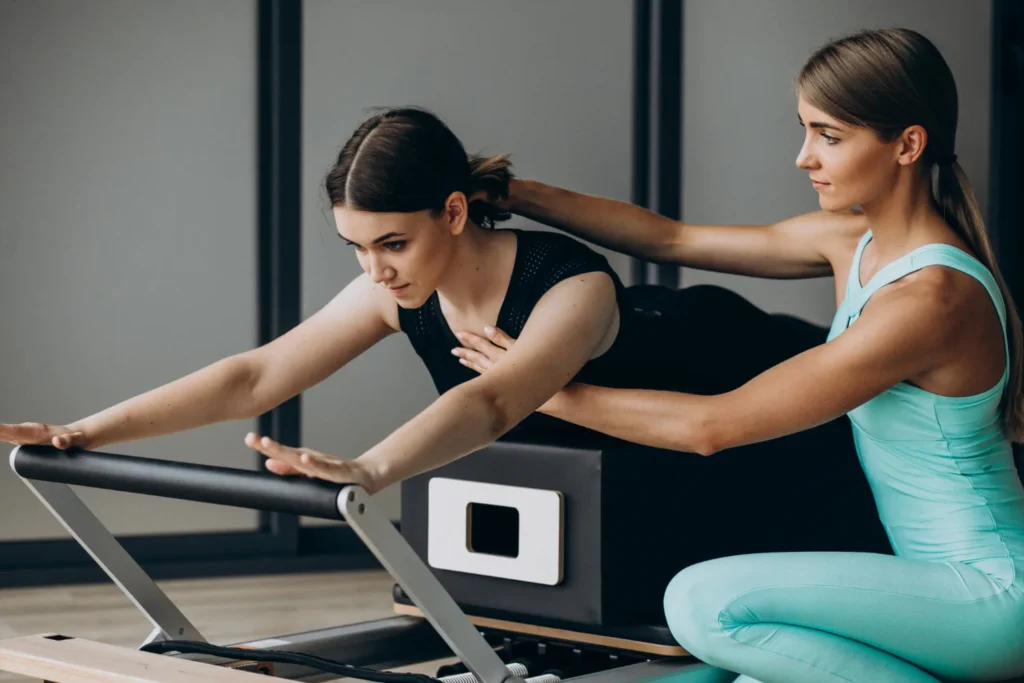
Reformer Pilates. A sliding carriage with spring resistance. This is the dominant format in the city, and the one most people mean when they search for reformer Pilates in Bangkok. It is mostly taught as group classes. Some studios cap the room at nine people, others run bigger groups, and that difference shapes how much correction you get.
Private and apparatus work. One-on-one or semi-private sessions, sometimes on larger equipment such as the Cadillac or the chair. This is where a teacher can adapt the work to an injury or a specific goal.
Hybrids. Hot mat, barre, jump-board cardio reformer, “high-intensity Pilates.” Some are good workouts. They are also a step away from the method itself, so judge them as fitness classes rather than as Pilates.
What the evidence says, and where the marketing runs ahead
The research on Pilates is real but modest in quality. Most trials are small, and many of the reviews rate their own evidence as low. Worth knowing before you believe a wall poster.
Pilates holds up well against doing nothing and roughly ties with other sensible exercise. That is a perfectly good reason to do it.
Back pain is the strongest case. A Cochrane review pooled ten trials with 510 participants and found low-quality evidence that Pilates reduces chronic non-specific low back pain compared with minimal intervention. The same review found no conclusive evidence that it beats other forms of exercise, and its authors note that the choice can reasonably come down to preference and cost. A later network meta-analysis comparing exercise types for chronic low back pain has been cited as ranking Pilates among the better-performing approaches, which fits the same message: a legitimate option, not the only one.
Flexibility and balance hold up too. A systematic review in healthy adults found strong evidence for improved flexibility and dynamic balance and moderate evidence for muscular endurance, while rating the overall scientific rigor of the studies as low. In older adults, a meta-analysis found some evidence that Pilates improves mobility, gait, postural stability, and fear of falling, all factors tied to fall risk.
Strength is where Pilates gets no special credit. A systematic review comparing Pilates with other exercises found very low to low certainty that Pilates and other modalities differ for strength, balance, or flexibility. Pilates can build strength, particularly if you are new to training. Nothing in the research suggests it replaces progressive resistance work, which is why we would pair it with the approach in our strength training guide rather than swap one for the other.
Body composition is the most overhyped claim. An umbrella review of 27 meta-analyses reported that Pilates can reduce BMI and body fat percentage compared with inactive or other interventions. Read the fine print, though: only one of those 27 reviews was rated high quality, one moderate, fifteen low, and ten critically low. An earlier systematic review concluded Pilates probably has no significant effect on body composition. The honest reading is that the effect, if real, is modest, and nobody should buy a Pilates package as a fat-loss program.
Red-flag language to watch for
- “Long, lean muscles” and “sculpt.” Marketing shorthand with no trial behind it.
- Slimming a named body part. Class titles that promise slimmer thighs or a smaller waist rely on spot reduction, which is not how fat loss works.
- Guaranteed results or fixed timelines. No honest exercise program can promise either.
- “Treats,” “corrects,” or “cures.” A studio that is not a clinic should not be promising to fix your back. The evidence supports Pilates as exercise, not as a cure.
Pilates classes in Bangkok: what they cost
Prices vary widely by studio, location, and whether you catch an introductory promotion. The table below reflects figures checked in October 2026 from studio websites and one local fitness guide. Treat it as a map of the range, not a quote.
| Format | Typical price (THB) | What to know |
|---|---|---|
| Group reformer, single class | 600 to 1,000 | One studio lists a standard price of 800 |
| New-client intro pack | About 3,700 for 10 classes | One studio’s offer, valid for two months |
| Short-term unlimited | 2,500 for 14 days | A new-client promotion at one studio, promotions change |
| Monthly unlimited | 6,000 to 12,000 | Depends on studio and location |
| Private session | 1,800 to 3,000 per hour | Intro privates can be cheaper, one studio lists 1,500 for first timers |
Mat classes are generally the more affordable option. Before you pay for anything, ask four questions: how long a class pack lasts before it expires, how late you can cancel before being charged, whether new clients are required to buy a private intro session, and whether you will be pushed into a long contract before trying a few classes. Good studios let you drop in or buy a small pack first. Some offer a free trial: Club Pilates in Bangkok advertises a free 30-minute introductory class.
Where to find Pilates studios in Bangkok
Pilates studios in Bangkok cluster along the BTS and MRT lines, which suits a city where nobody wants a long commute to a workout. The names below are examples drawn from public listings and the studios’ own sites. This is not a ranking, and we have not rated or visited them.
- Asoke and Chidlom. The Balance Pilates & Physio runs reformer group classes at Interchange 21 near Asoke and at Maneeya Center in Chidlom.
- Sukhumvit, Thonglor, and Phrom Phong. Swiss Pilates operates a flagship at Rain Hill on Sukhumvit 47 plus studios on Sukhumvit 31 and 10. Stretch Studio Pilates sits at Parks YARD on Sukhumvit 49, and Breathe Pilates is also on Sukhumvit 49.
- Lumphini, Silom, and Sathorn. Club Pilates has its Bangkok studio on the 18th floor of Grande Centre Point Lumphini on Rama 4. Pilates by Apittiya is in Sathorn.
- Ari and further out. Tri Bodyworks is in Ari, and Aira Studio is a boutique reformer studio in Bang Na.
Mall-based chains such as Absolute You also run Pilates programs in central locations, with a faster, workout-style feel than the more technical boutique studios.
How to choose a studio and a teacher
Pilates is self-regulated. There is no single governing body deciding who may teach it, and any organization can issue a certificate. That puts the burden on you.
Start with the teacher’s training. Ask which school certified them (Balanced Body, Polestar, STOTT, and BASI are the well-known names) and how many hours they completed. A comprehensive certification typically runs 450 hours or more over months, and a program that certifies someone after a single weekend is not a serious one. A good teacher will answer these questions without defensiveness.
Then watch how they teach. In a trial class, a strong instructor asks about injuries before you start, adjusts your position rather than just demonstrating, and can offer an easier or harder version of the same movement. Small groups make this easier. If the class is mostly choreography set to loud music and nobody looks at your form, you are in a fitness class, which is fine, but it is not what the research on Pilates is about.
What a first reformer class looks like
This is a researched description, not a first-person account. Studios describe their intro sessions as a walk through the basics and the equipment, and reviewers of first-timer classes often note that the pace is deliberately slower. Expect a short orientation to the carriage, springs, footbar, and straps, a question or two about injuries, and then a sequence of controlled movements with the teacher moving around the room. Your first class will probably feel slower than you expected and harder than you expected, usually at the same time. If a studio offers a first-timer class, take it rather than jumping into a general or intermediate session.
Who Pilates suits, and when to see a physio first
Pilates suits beginners, people returning to exercise, desk-bound professionals with stiff backs, older adults working on balance, and anyone who wants a low-impact complement to running or the gym. In a city where outdoor training is a daily negotiation with the heat, an indoor, low-impact option is also easy to keep up.
It is not a substitute for assessment. Sharp or radiating pain, numbness, pain that does not settle, recent surgery, or pregnancy are all reasons to talk to a doctor or physiotherapist and to tell your teacher before you start. For the broader picture on staying mobile at a desk, see our mobility guide below.
The short version
Pilates is well supported for chronic low back pain, flexibility, and balance, though the research is mostly small and rated low quality. It performs about as well as other sensible exercise rather than better, and it does not replace strength training, so treat fat-loss and “long, lean” promises as marketing. In Bangkok, expect roughly 600 to 1,000 THB for a group reformer class, with intro packs that make a trial cheaper. Before you commit, check the teacher’s training, the class size, and the contract terms, and take a trial class first.
This guide will be updated as Bangkok’s Pilates studios, prices, and research evolve. If you’re a Pilates instructor or physiotherapist and believe a detail here needs correction, contact us.
Sources
- Cochrane Database of Systematic Reviews (2015): Pilates for Low Back Pain
- Archives of Physical Medicine and Rehabilitation (2011): A Systematic Review of the Effects of the Pilates Method of Exercise in Healthy People
- Journal of Science and Medicine in Sport (2023): Pilates and Multiple Health Outcomes, An Umbrella Review
- Frontiers in Medicine (2021): Pilates Reducing Falls Risk Factors in Healthy Older Adults, A Systematic Review and Meta-Analysis