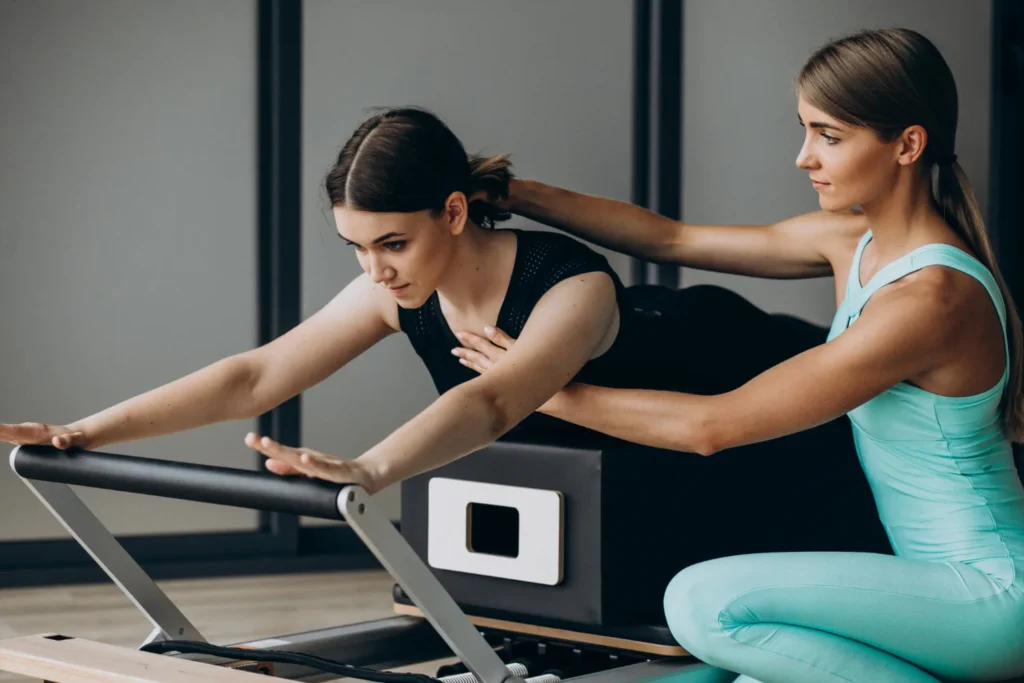
Mobility and flexibility in Bangkok get treated as a training afterthought — the five minutes tacked onto the end of a workout, if they happen at all. For anyone spending eight-plus hours a day at a desk, that ordering is backwards. This is often the missing piece that determines whether the rest of your training actually works.
Bangkok’s desk-bound professional population — office workers, remote employees, anyone whose day is mostly spent seated — shares a set of physical patterns that show up with remarkable consistency: tight hips, a stiff upper back, and a lower back that seems to complain regardless of how much core work gets done. This isn’t bad luck. It’s a predictable, well-documented response to how the body adapts to sustained positions, and understanding the actual mechanism changes how you’d approach fixing it.

Mobility and flexibility aren’t quite the same thing
Worth separating these terms, since they get used interchangeably but describe two different things. Flexibility is the passive range of motion available in a joint or muscle — how far something can stretch when an external force moves it there. Mobility is your ability to actively control and move through that range yourself — strength and coordination through the range, not just the availability of the range. A genuinely effective approach to desk-related stiffness needs both: enough available range, and the strength to actually use it, rather than stretching alone as the entire solution.
What actually happens to your body from sitting
Tissue adapts toward whatever position it spends the most time in. Sit with your hips flexed and your upper back rounded for eight hours a day, and your body gradually treats that as the new normal — hip flexors shorten, the thoracic spine (the middle and upper back, the section actually built for rotation and extension) loses range, and the glutes, rarely asked to do much work in a seated position, become less active than they should be.
Three areas consistently show up first when this pattern sets in: the hip flexors, the thoracic spine, and the posterior chain (glutes and the muscles supporting the lower back). Research on core stability and movement patterns has found that improving glute strength and hip extension capacity meaningfully reduces stress on the lumbar spine, and separately, that restoring thoracic mobility specifically helps reduce neck and shoulder discomfort — the compensation pattern that develops when the upper back stops rotating and extending the way it’s designed to.
“Stretching a tight hip flexor for thirty seconds a day can genuinely help. It won’t fix eight hours of sitting on its own — the fix is a combination of restoring range and actually strengthening the muscles that stopped doing their job.”
Why “just stretch more” oversimplifies the problem
A common instinct is to respond to stiffness with more aggressive stretching alone. The research suggests the issue is usually more layered than that: tightness from prolonged sitting isn’t purely a flexibility problem, it’s also a strength and motor-control problem — muscles that have been inactive for years don’t just need to be lengthened, they need to be re-taught to fire properly through that range. This is the actual distinction between mobility work and simple flexibility work, and it’s why a combined approach tends to outperform stretching in isolation.
A realistic routine that fits an actual workday
Given how much of the problem comes from sustained positioning rather than any single workout, the most effective approach layers three different time horizons rather than relying on one long weekly session:
- Movement breaks every 60–90 minutes. Simply standing, walking a short distance, or changing position reintroduces movement to joints that have been static — this alone meaningfully reduces the accumulated stiffness of a full workday.
- A short daily session, 5–10 minutes. Targeted work on the hip flexors, thoracic spine, and posterior chain — a handful of specific movements repeated consistently matters more than variety here.
- Two to three longer, more focused sessions per week. Deeper mobility and strength work through fuller ranges, building the control that daily micro-sessions alone don’t have time to develop.
A reasonable daily starting point covers a hip flexor stretch, a thoracic rotation drill (something like an open-book stretch), and a glute activation movement — three specific, well-targeted exercises consistently beat a longer, unfocused routine done occasionally.
The Bangkok-specific complication
A few things make this harder to solve here specifically than in a lower-density, more walkable city: commutes often involve extended sitting in traffic on top of a desk-based workday, doubling the daily sitting load beyond the office hours alone. Heat and humidity also discourage the kind of incidental movement — a walk around the block, standing outside for a call — that naturally breaks up sitting time in more temperate climates. Movement breaks in Bangkok often need to be deliberately built into an indoor routine rather than relying on the environment to prompt them the way a cooler, more walkable city might.
When it’s worth seeing a physiotherapist instead of self-directing
Self-guided mobility work handles a genuine majority of desk-related stiffness, but it’s worth a real physiotherapy assessment if pain persists despite consistent effort, if one side of the body is noticeably more restricted or painful than the other, or if numbness or radiating pain is involved — signals that go beyond simple positional stiffness and into territory a self-directed routine isn’t equipped to diagnose. Our Physiotherapy guide covers what that assessment actually involves and what it costs in this market.
The short version
Mobility and flexibility in Bangkok deserve more attention than the average desk-bound professional gives them — not as a five-minute afterthought, but as a deliberate combination of restoring range (flexibility) and rebuilding control through that range (mobility). The hip flexors, thoracic spine, and posterior chain are the three areas that consistently give out first from prolonged sitting, and a layered approach — frequent movement breaks, a short daily routine, and a couple of deeper weekly sessions — outperforms either stretching occasionally or ignoring it entirely.
If stiffness has become persistent pain rather than ordinary tightness, Physio Bangkok is well-positioned to assess what’s actually going on, rather than guessing your way through it alone.