Red light therapy has real evidence for a few specific uses, mixed evidence for muscle recovery, and none worth trusting for detox, weight loss, or testosterone. The devices in Bangkok’s studios are also rarely the ones used in the trials. Here is what the research supports, what sessions cost, and what to ask.
Red light therapy in Bangkok is sold everywhere: recovery studios, spas, aesthetic clinics, gyms, and physiotherapy clinics, with promises that run from muscle soreness to skin glow to hormones. Some of those promises have research behind them. Most do not, and the ones that do come from specific devices at specific doses that a walk-in session may not match.
This guide sorts the claims by evidence, explains why the device matters, gives Bangkok prices, and lists what to ask before you book. For how red light fits among sauna and cold plunge, see our recovery modalities guide.
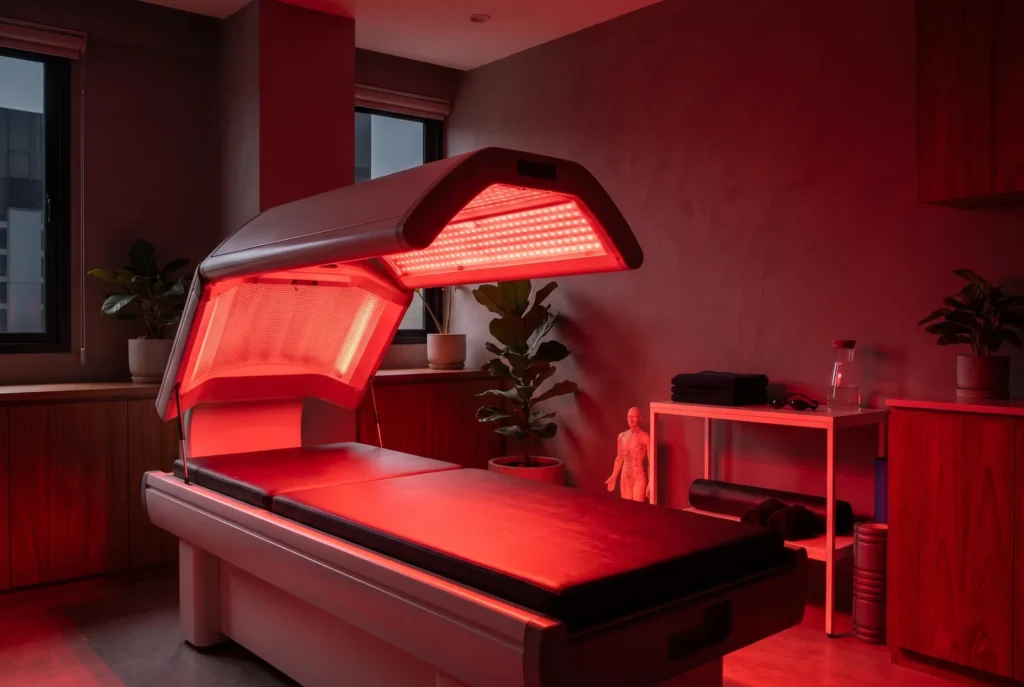
What red light therapy actually is
Photobiomodulation in Bangkok is mostly sold as “red light therapy.” Researchers call it photobiomodulation (PBM): exposing tissue to low-power red light, roughly 630 to 700 nanometers, or near-infrared light, roughly 800 to 950 nanometers. It does not heat, cut, or tan the skin. It used to be called low-level laser therapy, and the field adopted the new name in 2015 because many devices now use LEDs.
The leading explanation is that light is absorbed in the mitochondria, the cell’s energy machinery, and nudges inflammation and repair. That mechanism is a hypothesis, not a settled fact. What the clinical literature does show consistently is that dose matters: PBM is described as having a biphasic dose response, meaning too little light does nothing, a window helps, and much more is not better.
What the evidence supports
The research on red light therapy benefits is wide but shallow. The best single overview is a 2025 umbrella review in Systematic Reviews, which pooled 15 meta-analyses of randomized trials covering over 9,000 patients and 35 health endpoints. Twelve of the 35 showed a statistically significant effect, but the certainty of the evidence ranged from very low to moderate, and no outcome was supported by high-certainty evidence. The authors concluded that further high-quality trials and standardized protocols are needed before widespread clinical adoption.
| Use | What the research shows | How far to trust it |
|---|---|---|
| Mouth sores from cancer treatment | The best-studied use, supported by systematic reviews and a trial-sequential meta-analysis | Delivered with lasers in oncology settings, not in a spa |
| Burning mouth syndrome | Pain reduction with moderate certainty in the umbrella review | A specialist dental use |
| Fibromyalgia | Reduced fatigue with moderate certainty | Small trials, so an adjunct signal, not a cure |
| Hair density in androgenetic alopecia | One of the outcomes with a significant effect in the umbrella review | Uses scalp devices designed for it, and certainty was not high |
| Knee osteoarthritis and tendon pain | Osteoarthritis-related disability was among the better-supported outcomes, while tendon outcomes were weaker and less consistent | Mixed, and best seen as an add-on to exercise |
| Muscle soreness and exercise recovery | Positive but mixed, covered below | Timing and dose appear to matter |
| Skin lines and wrinkles | Some controlled trials show improvement, but reviews rate the evidence low quality | Cosmetic and modest |
For muscle recovery, a 2025 meta-analysis of trials on delayed-onset muscle soreness found improvements in soreness and in strength recovery at 24 and 48 hours, with moderate to large effect sizes, while its authors still called for more studies to confirm the findings. Earlier meta-analyses found that PBM improved performance and recovery mainly when applied before exercise, and that the benefit depended on the dose used. A 2025 systematic review of whole-body devices specifically, covering five studies and 105 people, reported a possible benefit for sleep but no clear improvement in exercise performance or recovery markers.
Red light has evidence as an add-on for some kinds of pain and soreness. It has none as a replacement for training, sleep, or a physiotherapist.
What it does not support
Some of the most heavily marketed claims have the weakest support. Bangkok listings advertise “detox,” “weight loss,” and testosterone increases, among other benefits.
- Detox. There is no recognised mechanism or trial evidence for a light-based detox.
- Weight and fat loss. We found only short trials, often run or funded by device makers, that measured a smaller waist circumference with no lasting fat loss. A smaller measurement is not the same as lost fat.
- Testosterone. We found no solid human trial showing that red light raises testosterone, and the claim rests largely on animal work and marketing.
- Mood, sleep, and “energy” in general. Whole-body trials hint at sleep benefits, but the evidence is early and small.
The pattern is typical of wellness marketing: a real effect in a narrow setting is stretched into a general-purpose benefit. The same caution applies to the sauna and cold plunge claims in our recovery modalities guide.
Why the device matters more than the label
Most positive trials used lasers or small LED clusters applied to a specific tissue, often by clinicians, at measured doses. A walk-in session on a full-body bed or a wall panel is a different thing. A review of 27 studies of LED light therapy for skin found that none reported any validation of the dose actually delivered, and that over a third were sponsored by the device manufacturer, with more run by commercial practices selling the treatment. Many consumer devices are simply not described in the evidence base.
That does not make a bed or panel useless. It means you should ask about the specifics: which wavelengths it emits, how long and how close the session is, and whether the output has been measured independently. It also means that “unlimited monthly access” sold on the idea that more is better runs against the biphasic dose response.
Red light therapy in Bangkok: what it costs
The red light therapy cost in Bangkok varies with the setting, and several figures come from the providers’ own pages and price directories. They were checked in November 2026.
| Setting | Typical price per session (THB) | What to know |
|---|---|---|
| Recovery or wellness studio | Roughly 480 to 900 | One studio lists 690 for a first visit, 6,900 for ten sessions, and 4,900 for monthly unlimited |
| Aesthetic or medical clinic | Often 1,500 or more | Frequently face-focused or bundled with other treatments |
| Directory-wide spread | About 150 to 3,500, median around 1,500 | One price index across 14 Bangkok clinics |
Ten-session packages generally run from about 4,000 to 12,000 baht. Our price guide shows how that compares with other recovery spending. Cheap sessions are not a problem in themselves. The point is to know what you are paying for, and to be wary of large prepaid packages before you have tried one session.
Who might reasonably try it
If you have neck, back, knee, or tendon pain, light can be a reasonable add-on to the exercise-based care our back pain guide, knee pain guide, and sports physiotherapy guide describe. If you are sore after hard training, it is a low-risk experiment with a plausible but modest upside. It is not a reason to skip strength work, sleep, or an assessment of persistent pain.
Safety
In trials, side effects were uncommon and mild. Even so, protect your eyes, since bright panels warrant care and you should not look directly into the LEDs. Tell the provider if you are pregnant, have or are being investigated for cancer, or take medicines or have skin conditions that make you sensitive to light. Pain that follows a serious injury, comes with fever, or involves new numbness or weakness needs a doctor before any clinic treatment.
Questions to ask before you book
- What device is it, and what wavelengths does it emit?
- How long is the session, how far is the light from my skin, and has the output been measured independently?
- What is it meant to do for my problem, and what is the evidence?
- Who runs it, and are they a licensed clinician?
- What is the price per session, and can I try one before buying a pack?
- What eye protection do you provide?
The short version
Red light therapy in Bangkok has genuine but narrow evidence: mouth sores from cancer treatment, burning mouth syndrome, fibromyalgia fatigue, hair density, and as an add-on for some musculoskeletal pain and muscle soreness, mostly at low-to-moderate certainty, with no outcome supported by high-certainty evidence. The claims for detox, weight loss, and testosterone are not supported by good human trials. Most trials used lasers or LED clusters at measured doses, not walk-in beds, and more light is not better. Sessions run roughly 480 to 3,500 baht depending on the setting, so ask about the device, the dose, and the price before you buy a package, and treat light as an add-on to exercise and good sleep, not a substitute.
Physio Bangkok is a physiotherapy clinic on Sukhumvit Soi 23 near Asok that offers full-body red and near-infrared light on a lounger-style bed, used alongside hands-on treatment and corrective exercise for pain and muscle tension. Its own page notes that most of the supporting trials used lasers or LED clusters and that whole-body research is newer and smaller. The first consultation is listed as free, and the page publishes no session price, so ask before you book and put the questions above to it as you would to any provider.